
Introduction
The SAP TM (Transportation Management) module allows companies to plan, execute, and optimize all transport operations within the supply chain. It covers both inbound and outbound flows while ensuring full visibility over shipments and associated costs.
Objectives and Benefits of the TM Module
SAP TM helps businesses efficiently organize their transport by considering multiple constraints: deadlines, capacities, costs, transport modes, and routes. It improves logistical performance, reduces transport costs, and ensures better delivery tracking. This module is primarily designed for logistics managers, transport planners, and supply chain teams responsible for steering and optimizing physical goods flows.
Core Functions of the SAP TM Module
1. Transport Planning
Planning is the heart of the SAP TM module. It organizes shipments by optimizing available resources while respecting operational constraints. The system accounts for orders, carrier capacities, routes, and deadlines to propose optimized transport plans. It also allows for the consolidation of multiple shipments to reduce costs and improve load factors. For example, SAP TM can automatically calculate the best route based on cost, distance, and CO2 emissions.
2. Transport Execution
Once planning is complete, SAP TM manages the execution of transport operations. This includes handling transport orders, communicating with carriers, and generating necessary documentation. This stage ensures that shipments are carried out according to plan while maintaining fluid coordination between supply chain stakeholders. SAP TM excels in managing complex flows combining Road, Rail, Air, and Sea (including container management, ocean bookings, etc.).
3. Tracking and Visibility
SAP TM offers advanced shipment tracking features. Users can monitor delivery progress in real-time and receive alerts in case of deviations or delays. This visibility allows for proactive management of contingencies, improving service quality and strengthening customer satisfaction.
4. Cost Management and Billing
The module integrates transport cost management from estimation to invoicing. It allows for the comparison of planned vs. actual costs to identify discrepancies. SAP TM thus facilitates the control of logistical expenses and contributes to better transport budget management. Furthermore, TM handles Self-billing: the system calculates the amount due to the carrier, avoiding the need to manually receive and verify thousands of paper invoices.
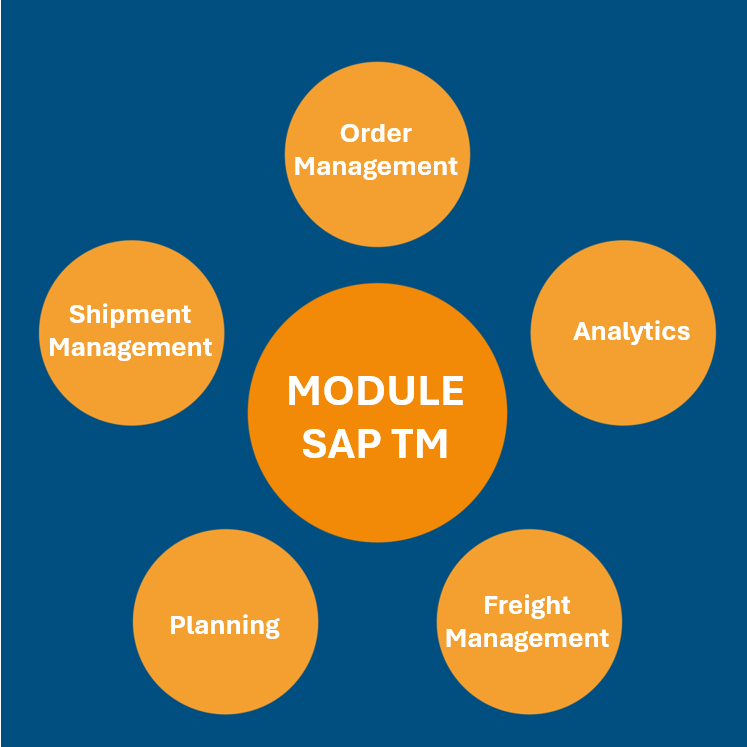
Integration with other SAP Modules
SAP TM naturally integrates with:
SAP FI/CO for the financial management of transport costs.
SAP MM / SAP SD for managing procurement and sales flows impacting shipments.
SAP EWM for warehouse management and logistical goods preparation. This interconnection ensures data consistency and centralization throughout the transport chain. Notably, integration with SAP EWM has become highly advanced with “Advanced Shipping and Receiving” (ASR), which synchronizes loading docks and transport orders in real-time.
Typical Use Cases
SAP TM is used for:
Organizing and optimizing national and international transport.
Managing multi-site and multi-warehouse flows.
Distribution to customers (downstream logistics).
Procurement from suppliers (upstream logistics).
Operations requiring real-time visibility and transport cost monitoring.
Key Advantages of SAP TM
- Transport cost optimization through advanced planning.
- Improved delivery deadline compliance.
- Reduction of inefficiencies through flow consolidation.
- Better collaboration with carriers and logistical partners.
- Increased operational visibility through real-time tracking.
Reporting in SAP TM
Reporting within the SAP TM module plays a vital role in steering transport operations. It provides logistics managers and supply chain teams with a clear, detailed view of flows, costs, and performance.
RapidViews business content for the TM module offers numerous standard reports to analyze transport costs, delivery times, service levels, carrier performance, and shipped volumes. These reports can be tailored to the specific needs of each organization.
One of the major strengths of SAP TM reporting is its ability to cross-reference data with other modules, such as SAP FI/CO for costs, SAP SD for sales, or SAP EWM for logistical flows. This provides a comprehensive, cross-functional view of transport operations.
By facilitating the analysis of gaps between planning and execution, SAP TM reporting helps quickly identify inefficiencies, optimize processes, and make informed decisions. It is an essential lever for improving overall logistical performance.
Conclusion
The SAP TM module is an essential tool for steering and optimizing transport operations in an integrated environment. It brings complete visibility to logistical flows, improves coordination between stakeholders, and enables better cost control. It is intended for logistics managers, planners, and supply chain teams looking to increase efficiency, responsiveness, and performance in their transport management.